Sirāt: Deserts Are Not Empty
Transnational Cinemas SIG
Paper proposal
Society for Cinema & Media Studies Conference
Montréal, Québec, 17-20 March 2027
Martin Roberts
Emerson College
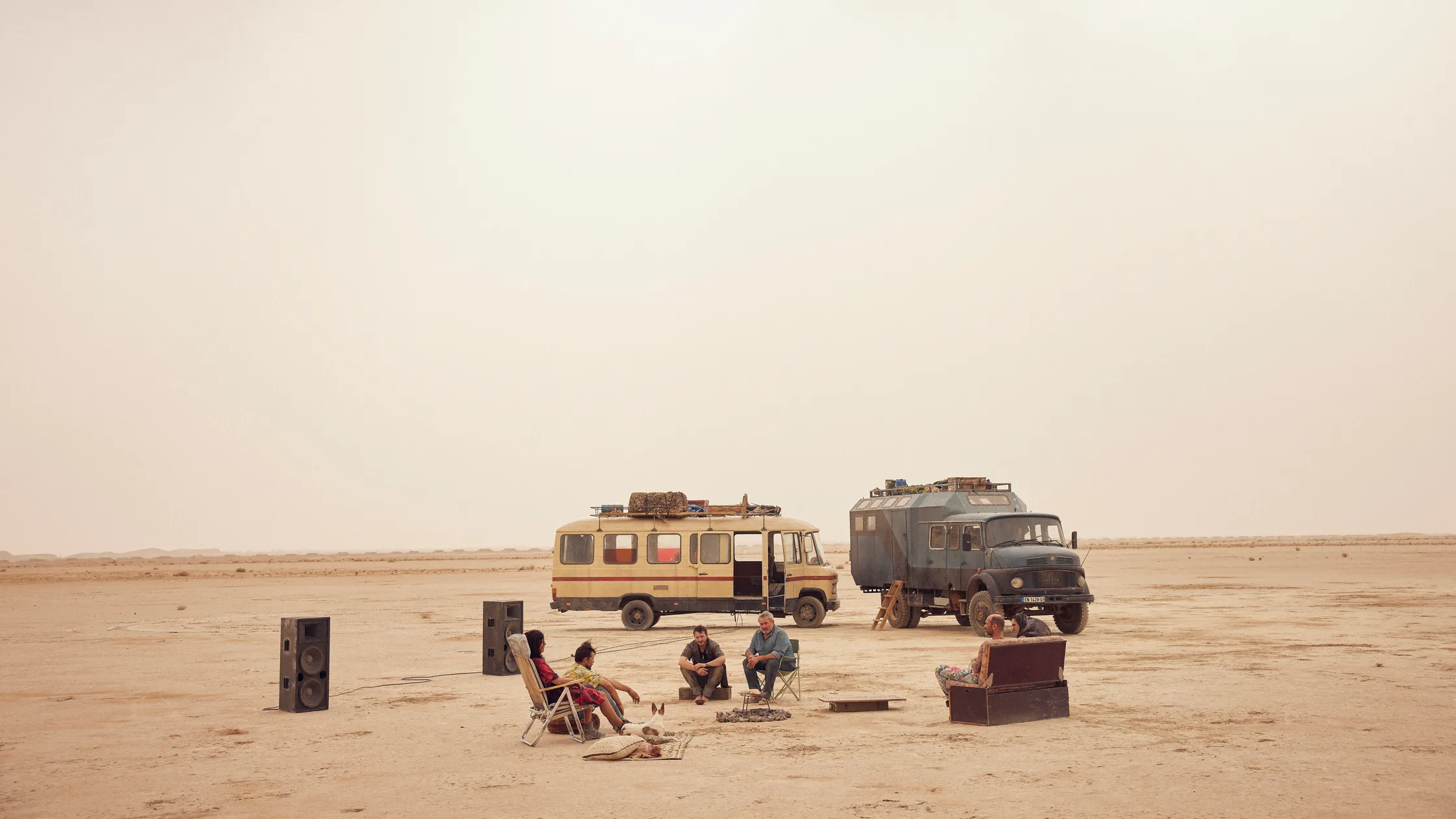
What are we to make of Sirāt (Óliver Laxe, 2025), other than as one of the bleakest depictions in recent cinematic history of the brutal randomness of the human condition? Or as further evidence in support of Bruno Latour’s contention that “we have never been modern”?
Shot mostly in the crushing heat of the Moroccan desert in the summer of 2024, the Spanish-French co-production was awarded the Jury Prize at the Cannes Film Festival 2025, in spite (or perhaps because) of its emotionally wrenching and graphic content. This paper attempts to make sense of the film by framing it in relation to two historical antecedents: the long history of cinematic representations of the desert in Hollywood and other world cinemas, including Lawrence of Arabia (David Lean, 1962), Fata Morgana (Werner Herzog, 1971), The Sheltering Sky (Bernardo Bertolucci, 1990), or Babel (Alejandro González Iñárritu, 2006); and more recent postcolonial cinemas that critique the cultural and environmental impacts of colonialism, such as Arwa Aburawa’s And Still, It Remains (2023) and Rachid Bouchareb’s Boomerang Atomic (2025), both about the French nuclear testing program in the Algerian desert in the 1960s.
While as the contributors to a recent collection of essays and creative writing pointedly titled Deserts Are Not Empty (Samia Henni, ed., 2022) argue, western cinema has typically depicted deserts within a colonial worldview, as empty spaces awaiting territorialization by imperial powers, the ravers of Sirāt soon discover that the apparently empty territory they occupy is traversed by local geopolitical struggles and the larger transnational forces that shape them. Even the supposedly pristine wilderness of the desert is striated by the minefield that ultimately obliterates most of the cast still left standing. Rave culture itself, while ostensibly a hedonistic alternative practice to western bourgeois society, is revealed as a fantasy of escape from the geopolitical landscapes that they seek to claim and inhabit like colonial settlers, and as just another form of alienation from the brutal realities of the world. As Ivan Niccolai argues, the teknival’s promise of permanent freedom is itself underwritten by the very infrastructures of labour and industry it imagines itself outside of, so that when those infrastructures fall away only older forms of violence remain (Niccolai 2026).
While Sirāt’s vision of the world may seem unremittingly bleak, the paper argues, the film can be read as a scathing indictment of human alienation both from the planet itself and of the societies that continue to contest its sublime landscapes.
Bibliography
Alcoz, Albert. “Cinematic Dunes: The Configuration of the Desert in Experimental Film and Video Art.” L’Atalante. Revista de estudios cinematográficos, no. 37 (January–June 2024): 147–160.
Baggesgaard, Mads Anders. “Picturing the World: Cinematic Globalization in the Deserts of Babel.” Journal of Aesthetics & Culture 5 (2013): 1–9.
Gandy, Matthew. “The Cinematic Void: Desert Iconographies in Michelangelo Antonioni’s Zabriskie Point.” In Landscape and Film, edited by Martin Lefebvre, 315–31. New York: Routledge, 2006.
Samia Henni, “Against the Regime of ‘Emptiness.’” In Samia Henni, ed. Deserts Are Not Empty. New York: Columbia Books on Architecture and the City, 2022: 11-22.
---. “Terra Nucleus: Radiating Desert Lives.” In The Funambulist 44 (November-December 2022): 60-67.
Mann, Daniel. “Red Planets: Cinema, Deserts, and Extraction.” Afterimage 49, no. 1 (March 2022): 88–109.
Niccolai, Ivan. “Sirat, Exocapital & Europe’s Beautiful Souls.” TripleAmpersand Journal (&&&) (August 2026).
“The Desert.” The Funambulist: Politics of Space and Bodies 44 (November-December 2022).
Filmography
Lawrence of Arabia (David Lean, 1962)
Fata Morgana (Werner Herzog, 1971)
The Sheltering Sky (Bernardo Bertolucci, 1990)
The King Is Alive (Kristian Levring, 2000)
Exils (Tony Gatlif, 2004)
Babel (Alejandro González Iñárritu, 2006)
Mad Max: Fury Road (George Miller, 2015)
El Mar La Mar (J.P. Sniadecki, 2017)
And Still, It Remains (Arwa Aburawa and Turab Shah, 2023)
Boomerang Atomic (Rachid Bouchareb, 2025)
Sirāt (Óliver Laxe, 2025)
Reggane (Rachid Bouchareb, in production)