W1: Introduction: Sites of Struggle
Where to begin?
On the most fundamental level, the field of media today can be described as a site of struggle—or more accurately, as a multiplicity of sites of struggle: struggles over the representation and interpretation of real-world events; struggles over identity and whose voices are heard (and whose not); struggles over the political use of media, whether as a tool of corporate or state control, or resistance to it; struggles over ownership and property rights; struggles over media ethics; struggles over creativity and aesthetics; struggles over the environmental impact of media and communication technologies, and many more.
Perhaps most importantly, though, today’s digital, networked media technologies and social media platforms are sites of struggle over meaning: over the often multiple, often contradictory meanings of media texts, practices, or rituals. The task of media criticism arguably begins with the question of meaning: what certain forms of cultural or media expression mean to different publics and audiences, and how meaning itself is not inherent or self-evident, but socially constructed by the often contradictory interpretations of different communities.
Within this larger, continually evolving field of meaning-making, media criticsm involves the analysis and decoding of media texts within specific interpretative frameworks, some of which we will be exploring in this course. They are drawn from a multiplicity of fields of knowledge in the humanities and social sciences, including linguistics (semiotics) (Eco 1986), literary theory (narrative), political economy (Marxism), psychoanalysis, social theory, feminism (Negra and Tasker 2007), ethnography, and cultural studies (Hall 1980).
The fact that the interpretations of the same media texts are frequently contradictory doesn’t mean that they are equivalent in value in a relativistic way. On the contrary, many of the historical and still ongoing struggles over media meangings are struggles over power—over whose media practice, whose interpretation, is the dominant or valid one. It is often the practices and intrepretations of the most dominant groups within a society, or between societies, that are held to be the most valid ones. But resistant intrepretations and practices are always present, even when repressed, and may challenge or destabilize those of dominant socio-political groups.
A Contemporary Example: Ghiblification
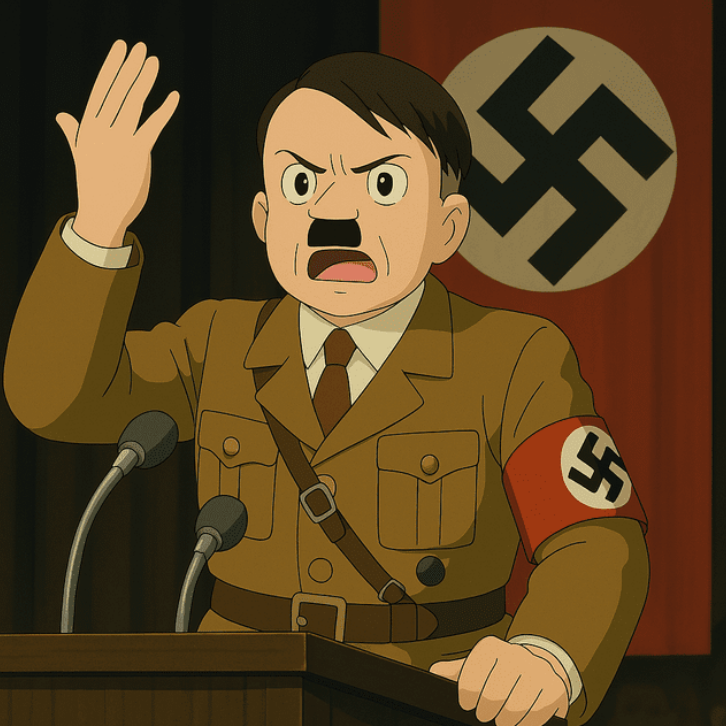
If all this sounds very abstract, it is useful to begin with a concrete example that exemplifies many of the preceding points. The example that I propose we consider this week is a very recent media practice that first emerged last spring (2025) and quickly became a site of struggle in all of the ways described above. It relates to generative AI—already in itself a huge site of struggle over the past few years—and specifically the upgrade to OpenAI’s ChatGPT tool last spring that introduced a new affordance that quickly became nothing less than a global media phenomenon: the ability to convert any photograph into the distinctive visual style of the globally popular Japanese animation studio, Studio Ghibli, using only a simple textual request (e.g. “Convert this into a still from a Studio Ghibli movie”). As with all of meme culture, many of the hundreds (probably thousands) of images generated quickly spread across social media platforms.
I expect that all of you may have come across the phenomenon at the time, since it was so ubiquitous, but you may have been less aware of its scale and the controversies sparked by many of the practices that emerged from it. In case you missed it, though, and to get a sense of the scale of the phenomenon, take a look at this slideshow that I put together at the time.
Among the wildfire of controversies generated by the AI-Ghibli phenomenon, perhaps the most unexpected–often shocking–was its use use in political and indeed geopolitical contexts. To the outcry of many, even the White House appropriated the trend as part of its clampdown on immigration by posting a Ghiblified image on its official Instagram feed. But this was not an isolated event: take a look at this Twitter thread about the Israel-Hamas war in Gaza.
As you can see from the initial posts on the thread, it appears that the posting of Ghiblified photographs relating to the Gaza conflict was initiated by the Israeli Defence Force, but if you continue scrolling you will see that the practice was also used by pro-Palestinian or anti-Zionist sources. Just scrolling through this feed alone, I think you can see what I meant earlier by describing media as a site of struggle.
While this may seem like a particularly complex example, I would argue that it’s actually quite typical of the complexities of contemporary media culture and the challenges it poses to the analysis of that culture. Within meme culture alone, one need only consider the strange afterlife of the Pepe The Frog meme, which was the subject of the documentary Feels Good Man (dir. Arthur Jones, 2020). If you haven’t seen it, I highly recommend that you watch it, as it’s extremely relevant to our course!
As a cultural and political practice, media criticism sets out to make sense of all of this. How does it do this? What kinds of frameworks would enable us to understand examples such as the AI-Ghibli phenomenon or the alt-right’s political appropriation of the Pepe The Frog meme in the lead-up to the 2016 US election? Who would have thought that the charming visual style of Studio Ghibli’s much-loved films, many directed by the self-professed pacifist Hayao Miyazaki, would be appropriated as what appears to be a contemporary form of propaganda? Why would the White House, the IDF, or other political actors appropriate that style? What are they trying to communicate by doing so? I leave you to consider such questions, and am curious to hear what you think.
If you were wondering, then, why I assigned you to read one of the early chapters from Welch (1993) study of propaganda in the Third Reich, or Eco (1986) chapter on what he calls “semiological guerrilla warfare”, then by now you may have a better understanding why. Even though Eco’s concept dates from the early 1980s, the AI-Ghibli images amply demonstrate that the age of social media, still several decades away at the time, is today very much a field of semiological guerrilla warfare—not just a war in the human sense but also a war of signs: the signs in question being the existing global cultural mythology of Studio Ghibli itself, which is appropriated in different contexts and for different political purposes as a kind of second-order ideological language. This appropriation of an existing corpus of signs within (global) culture is one of the fundamental practices of what Barthes (1972) called “Mythologies” in his 1957 book of the same name: the process by which ideology presents itself as “normal” or “natural” rather than historical and dependent on highly unequal political, economic, and social dynamics.
A wider question raised by the examples I’ve been discussing are about the nature of propaganda itself. What exactly is “propaganda”? Welch (1993) offers some useful starting points for reflecting on this subject, and its relevance to contemporary geopolitical contexts. If you’re interested in exploring this subject further, you’ll certainly need to watch Leni Riefenstahl’s film Triumph of the Will (1935), regarded as the classic text of the Nazi propaganda machine. It still makes for chilling viewing today.