
W7: Revenge of the Nerds: Fandom
Making great music and being great on stage no longer seem to be enough.
—Nancy Baym
Are you a superfan? Or just a fan? Who are you a fan of?
Nancy K. Baym, “Social Media and the Struggle for Society”
Nancy K. Baym, Daniel Cavicchi, and Norma Coates, “Music Fandom in the Digital Age: A Conversation”
See also: Lauren Mayberry, “Chvrches’ Lauren Mayberry: ‘I will not accept online misogyny’” (The Guardian, 30 September 2013.
Whether it’s a band, a filmmaker, an influencer, a sports team, or a videogame, we are all fans of somebody or something now. Fandom today is a social obligation, an expected marker of normal socialization: to not to be a fan of anything is weird, an indicator of social alienation. But even the socially alienated—known in Japan as otaku (roughly, nerds) or in extreme cases, hikikomori (shut-ins, who never leave their room and spend all their waking lives immersed in online gameworlds) are fans, even superfans. It’s not always been this way, of course. Back in 1986, nerdy Star Trek fans were still being lampooned in SNL comedy skits. Even back then, though, nobody would have considered telling obsessive sports fans to “get a life”, because being a fan of an actual sports team was not considered as excessive. But Star Trek was “just” a TV show, whose legitimacy as an object of such excessive devotion was far less obvious, given the longstanding (and still persistent) perception of television as trivial entertainment. This also explains, by the way, why fandom only began to be taken seriously in academia as a legitimate object of study from the 1990s onwards, beginning with Henry Jenkins’s classic study of Star Trek fandom Textual Poachers in 1992, and soon after Constance Penley’s NASA/Trek Other areas of media fandom, particularly around Japanese anime, have taken much longer to establish their legitimacy. It can be seen from these examples that perceptions of fandom are intertwined with the status within the dominant culture of the media or platforms that are the object of the fandom in question (popular music, film, TV, videogames, anime, TikTok).
Henry Jenkins, Textual Poachers: Television Fans and Participatory Culture (New York: Routledge, 1992).
Constance Penley, NASA/Trek: Popular Science and Sex in America (New York: Verso, 1997).
Fast forward a few decades, and as you see from the discussion about music fandom between Nancy Baym, Daniel Cavicchi, and Norma Coates, fandom has become a large and well-established field within media studies and related fields (cultural studies, ethnography). No longer stigmatized as in the 1990s, the nerd has become a staple of mainstream entertainment, from Napoleon Dynamite to The Big Bang Theory and its spinoff, Young Sheldon. How, when, and particularly why this cultural shift happened is a larger set of questions that there isn’t space to adequately address here, but has also been the subject of much theorizing in the academic literature on fandom.
So much for the background; but let’s come back to the specific focus of the second article assigned for this week: music fandom and its changing modalities in the emergence of digital culture and social media since the 1990s. For reasons explained above, books such as Kaitlyn Tiffany’s first-person study of One Direction fans are today routine. It’s fine to publicly obsess over Harry Styles or other boy-band idols, while media scholars are devoting entire academic syllabi to Taylor Swift. Since fandom today has become such a vast field, then, I’ll limit myself to a couple of observations arising from the article on music fandom in the social media age that may provide some starting points for this week’s discussion.
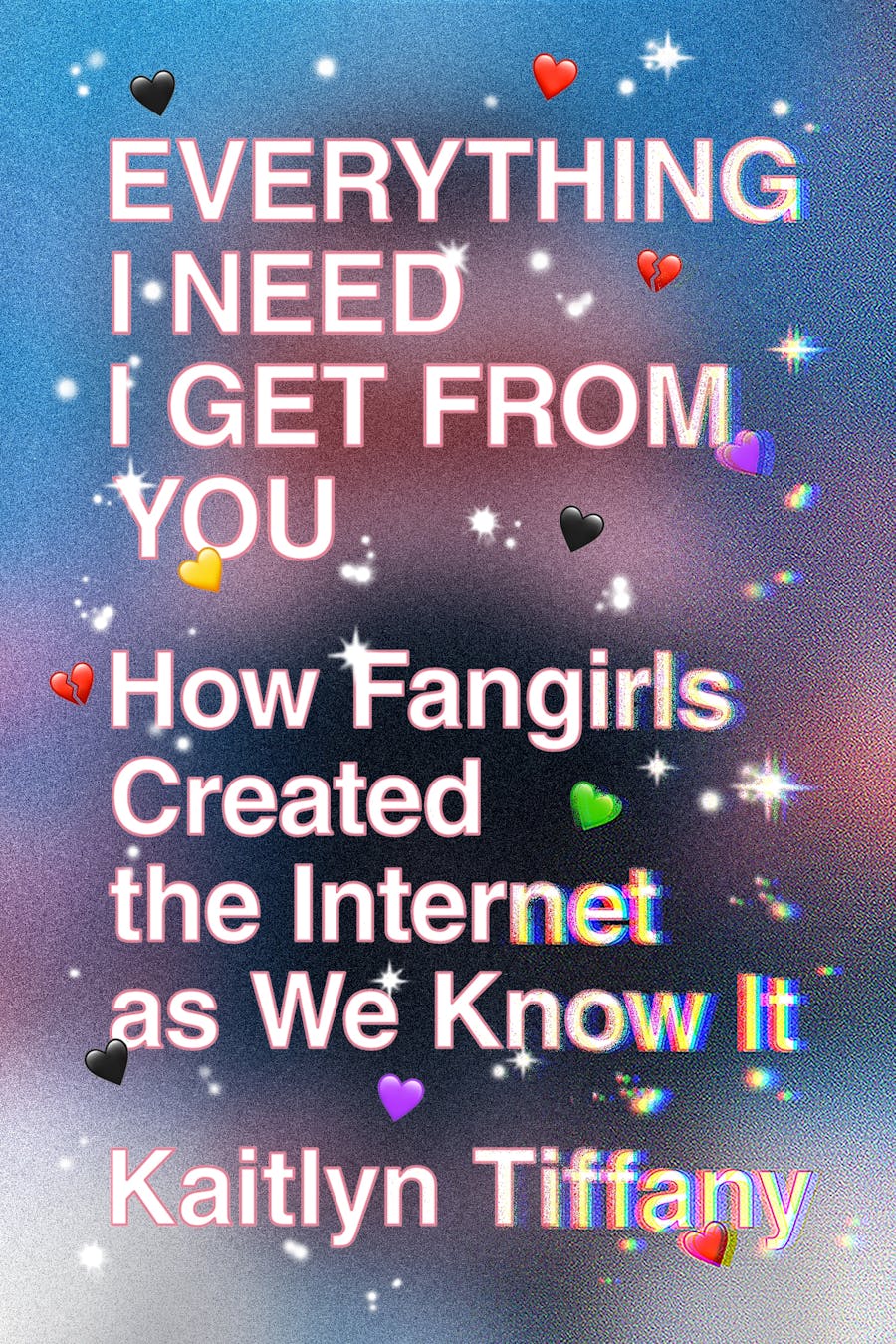
Kaitlyn Tiffany, Everything I Need I Get From You: How Fangirls Created the Internet as We Know It (New York: Farrar, Strauss & Giroux, 2022).
The first of these relates to the question of race in relation to fandom. On the last page of the discussion of music fandom, Nancy Baym observes:
I think, for example, of black punks, and how they, like punk women (and, most of all, like black punk women), have already been written out of histories of punk. Fan scholarship has begun to talk about race, as phenomena like casting white actors to play Asian characters has become a topic that increasingly merits discussion beyond the purviews of fandoms themselves (151).
While Baym’s point itself is valid enough, it’s significant that it’s is the only reference to race in this discussion of music fandom by these three white scholars. While (as is clear from the discussion) the relationship between fandom and gender identities has been a major focus of attention in academic discussions of fandom, from Beatlemania to One Direction, it’s also true that until relatively recently the field of fandom studies has been overwhelmingly dominated by studies of predominantly white fandoms by white scholars who have largely ignored racial and ethnic identities in relation to fandom. While there has been some diversification within the past decade or so, to my mind this remains very much the case even today. Where, say, black fandom has been discussed, it’s been primarily focused on hip hop and/or Afrofutursm, as if these cultural forms were co-extensive with black cultural identity. But this is far from being the case, as both the controversial but longstanding white fandom for hip hop or anime attest, as well as the even more longstanding black fandom for hardcore and punk music. For more on the latter, I recommend the excellent documentary Afro-Punk (dir. James Spooner, 2003). Other than such isolated studies, there remains considerable scope today for exploring the question of race in music fandom and in other fandoms beyond it.
The Bots, “Stop” (2010)
The second point is in relation to Daniel Cavicchi’s reference (p. 144) to the transcultural dimension of contemporary global fandom. While the most obvious contemporary example is the global fandom around K-pop, fandom was transcultural long before the viral success of “Gangnam Style”—consider for example the US fandom for Japanese anime since the 1970s, or conversely, the Japanese fandom for hip hop (not to mention countless other western musical styles and genres). Today, however, it’s undeniable that the global fandoms around K-pop and other elements of the “Korean Wave” are the best example that fandom has arguably always been transcultural.
Ian Condry, Hip-Hop Japan: Rap and the Paths of Cultural Globalization (Durham, N.C.: Duke University Press, 2006).
Last spring (perhaps like some of you), I visited the “Hallyu! The Korean Wave” exhibition at the Museum of Fine Arts in Boston, which included an extensive section devoted to K-pop. Like the London exhibition that preceded it, the MFA exhibition was wildly successful, attracting large numbers of K-pop fans. Over the past decade, K-pop and the global fandoms swirling around it have been the subject of countless academic studies, and today it constitutes an academic subfield in its own right. At the time of writing, the K-pop rollercoaster shows no sign of slowing down: after three seasons of Netflix’s Squid Game, the runaway hit of the summer is a 3D animation movie that you might possibly have heard of called K-Pop Demon Hunters (2025). While the older transcultural fandoms for Japanese media products continue, they have long since been eclipsed by K-pop’s domination of transcultural pop fandom. What are we to make of all this? Why is it that K-pop seems to resonate with such culturally different audiences around the globe? These are questions that continue to be studied by transcultural fandom scholars today.
Academic studies of fandom have for too long remained focused largely on national cultural contexts, from Star Wars to Dr. Who. In the age of global streaming and social media platforms, however, it’s clear that music fandom has been transforming almost before our eyes, as global K-pop is joined by a host of other hybridized musical styles spawned by local fandoms for internationally circulating styles, from psychedelia to punk to heavy metal to EDM. Perhaps the biological phenomenon of spawning, indeed, may provide the best metaphor today for the musical ecosystems swarming around the globe, and the fandoms that sustain them. In such an environment, there’s no knowing what may be the next thing to crawl out of the pond, but the next generation of Demon Hunters will surely be waiting for it.